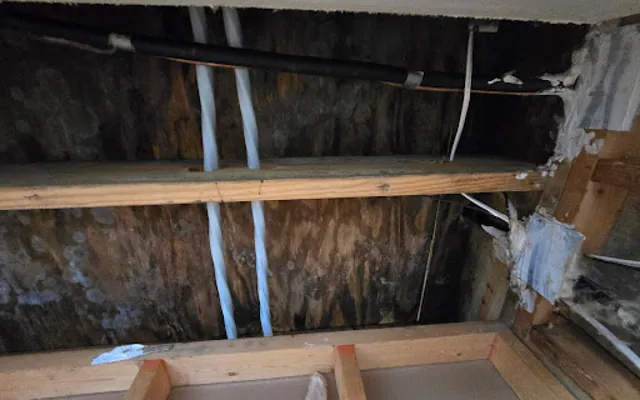
Between heavy mountain snow working its way under shingles and sudden summer hailstorms testing the roof deck, Denver attics see water intrusion from more than one direction. Crews respond 24/7 to dry wet insulation, decking, and framing before it spreads to the ceilings below.

The crew inspects the attic to confirm the intrusion source, whether ice dam meltwater, storm damage, or a vent issue, and maps how far the water traveled.
Wet insulation is removed since it cannot be dried effectively and can hold moisture against the decking and framing.
Air movers and dehumidifiers dry the roof decking and structural framing to a measured target, checking for any soft or compromised sections.
Moisture readings confirm the space is dry, the loss is photographed and logged for the claim, and the roofing issue that caused the leak is noted for repair.

While help is on the way, these first steps, done only where it is safe, limit the damage and protect the insurance claim.
Shut the supply off at the source, or close the home's main valve if the source is not obvious. Stopping the flow limits the damage more than anything else.
Switch off electricity to the affected area, but only if the breaker can be reached without standing in or touching the water.
Get a crew dispatched right away. The sooner extraction and drying begin, the more flooring, drywall, and belongings can be saved.
Take photos and a short video of the water and the affected rooms before anything is moved, so the insurance claim starts strong.
Attic water damage cleanup in Denver typically runs from about $900 to $4,000, depending on how much insulation has to be removed and how far the moisture spread into the decking, framing, and ceiling below before it was found. A contained intrusion caught soon after a storm sits on the low end, while a slow leak that soaked insulation across a large section of attic and stained a ceiling below sits on the high end. Sudden storm or ice-dam related attic damage is commonly covered under a homeowner policy, and the loss is documented, including photos of the source, for the claim.
Crews reach Denver and the nearby metro fast, from Capitol Hill, Five Points, and Highland to Wheat Ridge, Lakewood, Englewood, and Arvada. See the full list on the areas served across Denver page.
See all areas servedEvery loss is photographed, measured, and logged from the first visit, so the paperwork holds up with the insurance carrier.
Technicians follow recognized IICRC drying standards and prove it with daily moisture readings on Denver homes, not guesswork.
Emergency dispatch any hour of the day or night, with a real crew on the way across the metro, not a callback in the morning.
A real crew dispatched any hour, not a callback in the morning.
Trained technicians following recognized IICRC drying standards.
Truck-mounted, portable, and submersible for any size loss.
The loss is documented and billed to the carrier directly.
Ice dams backing meltwater up under the shingles in winter, storm or hail damage to the roof in summer, and improperly vented bathroom or kitchen exhaust fans that dump moisture into the attic year-round are the recurring causes here.
Generally no. Wet insulation loses most of its insulating value and holds moisture against the roof decking and framing, which raises mold risk, so it is typically removed rather than dried in place.
A ceiling stain, a musty smell, or a noticeable jump in heating or cooling bills from compromised insulation are the usual signs, since the attic itself is rarely checked directly.
Sudden damage from a storm or hail event is commonly covered under a standard homeowner policy. Damage from a long-standing issue like an unducted fan may be treated differently, which is why the source is documented as part of the claim.
No. The crew handles the water damage itself, drying and documenting the affected insulation, decking, and framing. Roof repairs or venting corrections are handled by a qualified roofer or HVAC contractor, and the homeowner is pointed toward that separately.
Denver crews are on call 24 hours a day, local and fast, and can be on the way within the hour.
Call (720) 807-8315