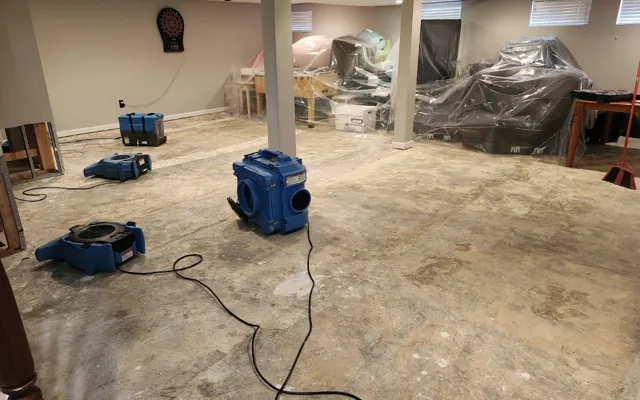
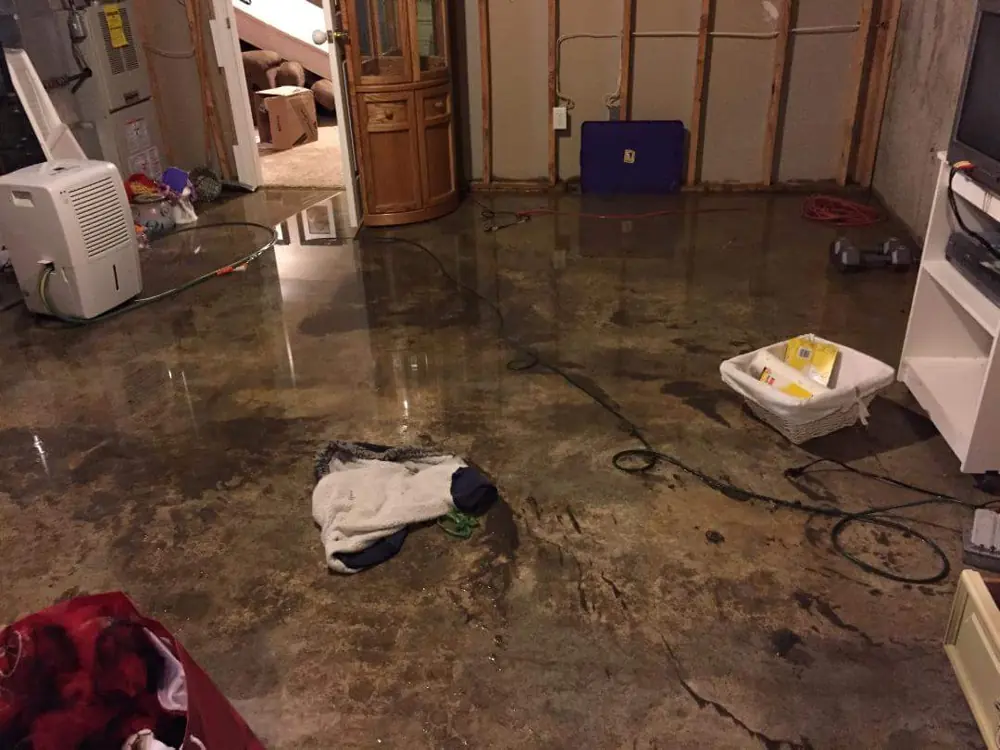
A sump pump is the last line of defense for a Denver basement, and when it fails, groundwater and hydrostatic pressure take over fast. Crews respond around the clock to extract standing water and dry the basement before it spreads further.

A crew is typically on-site at a Denver home within about an hour to confirm the pump has failed, check electrical safety around standing water, and assess the sump pit.
Backup submersible pumps and truck-mounted units take over where the failed sump left off, clearing standing water from the basement floor fast.
Wet baseboards, pad, and drywall are addressed, with flood cuts made where drywall stayed wet long enough to wick moisture upward.
Dehumidifiers and air movers run until meters confirm the slab, framing, and wall cavities are back to a dry, stable reading, with results logged for the claim.

While help is on the way, these first steps, done only where it is safe, limit the damage and protect the insurance claim.
Shut the supply off at the source, or close the home's main valve if the source is not obvious. Stopping the flow limits the damage more than anything else.
Switch off electricity to the affected area, but only if the breaker can be reached without standing in or touching the water.
Get a crew dispatched right away. The sooner extraction and drying begin, the more flooring, drywall, and belongings can be saved.
Take photos and a short video of the water and the affected rooms before anything is moved, so the insurance claim starts strong.
Cleanup after a Denver sump pump failure typically runs from about $1,200 to $4,500, depending on how long the pump was down, how much of the basement was affected, and whether drywall or pad needs replacing. A quick failure caught within hours and limited to bare concrete sits toward the low end; a finished basement soaked overnight sits toward the high end. Sudden mechanical failure of equipment like a sump pump is commonly a covered loss, and moisture readings and photos are documented to support the claim regardless of the outcome.
Crews reach Denver and the nearby metro fast, from Capitol Hill, Five Points, and Highland to Wheat Ridge, Lakewood, Englewood, and Arvada. See the full list on the areas served across Denver page.
See all areas servedEvery loss is photographed, measured, and logged from the first visit, so the paperwork holds up with the insurance carrier.
Technicians follow recognized IICRC drying standards and prove it with daily moisture readings on Denver homes, not guesswork.
Emergency dispatch any hour of the day or night, with a real crew on the way across the metro, not a callback in the morning.
A real crew dispatched any hour, not a callback in the morning.
Trained technicians following recognized IICRC drying standards.
Truck-mounted, portable, and submersible for any size loss.
The loss is documented and billed to the carrier directly.
Common causes include power outages during storms, a float switch that sticks, a clogged intake screen, or a motor that simply reaches the end of its life, often right when heavy snowmelt or a downpour puts the most demand on the system.
It depends on how fast groundwater is entering and how long the failure goes unnoticed. An overnight or away-from-home failure during snowmelt season can mean several inches across the basement floor by the time it is discovered.
Cleanup and extraction come first so ongoing water intrusion stops and drying can begin. A qualified plumber can then assess and replace the sump system separately.
Sudden mechanical failure of equipment like a sump pump is commonly covered, though coverage specifics depend on the policy. Detailed moisture readings and photo documentation are provided to support the claim either way.
A battery backup system and regular testing before snowmelt and monsoon season both help, though ultimately that is a conversation for a qualified plumber to walk through.
Denver crews are on call 24 hours a day, local and fast, and can be on the way within the hour.
Call (720) 807-8315