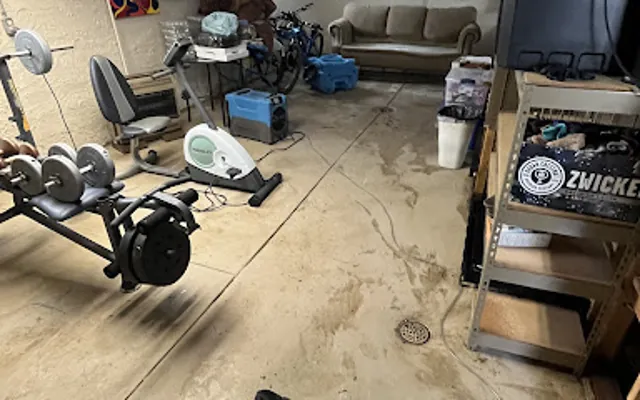
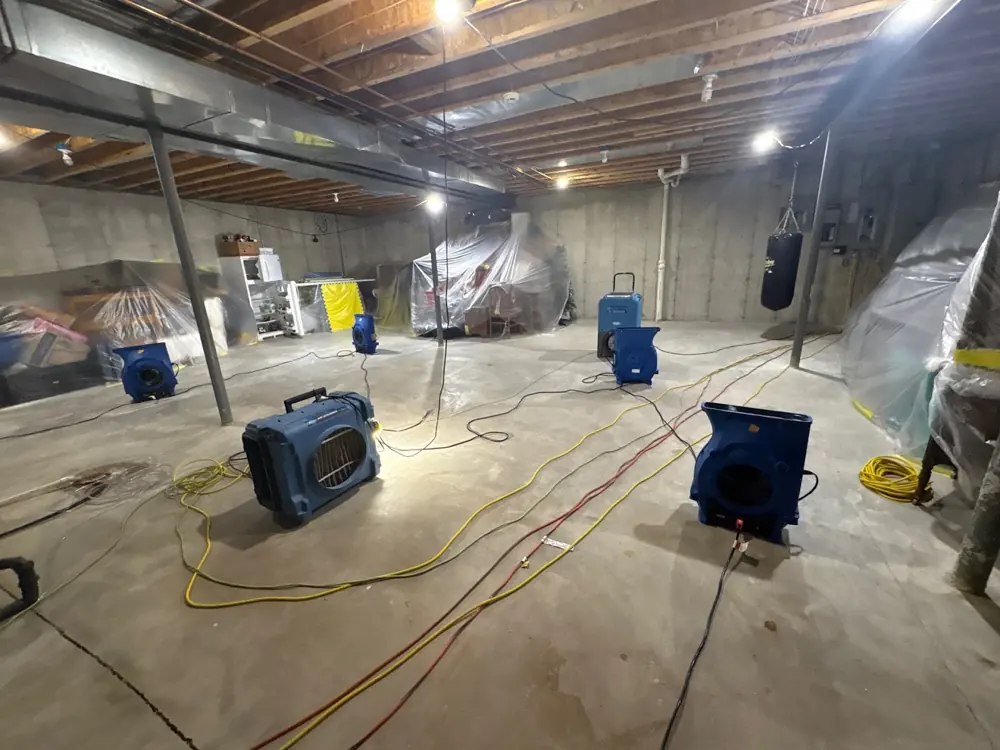
Denver's housing stock leans heavily on full basements, so a true slab leak is less common here than in warmer regions, but it still happens on slab-built additions, garages, and the newer infill and townhome construction going up around the city. When a supply line under a slab fails, crews extract, dry, and document the damage.

The crew maps how far the water has traveled under the flooring using moisture meters and thermal imaging before any material is disturbed.
Any water that has surfaced through flooring seams or baseboards is extracted immediately.
Flooring materials that trapped moisture against the slab, carpet, pad, or engineered wood, are lifted or removed so the area can dry properly.
The homeowner is pointed to a qualified plumber to locate and repair the actual slab leak while the structure is dried and verified with documented readings.

While help is on the way, these first steps, done only where it is safe, limit the damage and protect the insurance claim.
Shut the supply off at the source, or close the home's main valve if the source is not obvious. Stopping the flow limits the damage more than anything else.
Switch off electricity to the affected area, but only if the breaker can be reached without standing in or touching the water.
Get a crew dispatched right away. The sooner extraction and drying begin, the more flooring, drywall, and belongings can be saved.
Take photos and a short video of the water and the affected rooms before anything is moved, so the insurance claim starts strong.
Slab leak water damage cleanup in Denver typically runs from about $1,000 to $4,000 for the water damage portion, not counting the plumbing repair itself, which a qualified plumber quotes separately. Cost depends on how long the leak ran undetected and how much flooring has to be lifted or removed to dry the slab properly. A leak caught early from a rising water bill sits on the low end, while one that went unnoticed for weeks and soaked engineered wood or carpet across a room sits on the high end. Sudden slab leaks are often covered under a homeowner policy for the resulting water damage, and the loss is documented for the claim.
Crews reach Denver and the nearby metro fast, from Capitol Hill, Five Points, and Highland to Wheat Ridge, Lakewood, Englewood, and Arvada. See the full list on the areas served across Denver page.
See all areas servedEvery loss is photographed, measured, and logged from the first visit, so the paperwork holds up with the insurance carrier.
Technicians follow recognized IICRC drying standards and prove it with daily moisture readings on Denver homes, not guesswork.
Emergency dispatch any hour of the day or night, with a real crew on the way across the metro, not a callback in the morning.
A real crew dispatched any hour, not a callback in the morning.
Trained technicians following recognized IICRC drying standards.
Truck-mounted, portable, and submersible for any size loss.
The loss is documented and billed to the carrier directly.
Less common than in cities built entirely on slab, since most Denver homes have full basements. They do happen in slab additions, attached garages, and newer slab-built infill and townhomes.
A warm or unexplained damp spot on the floor, a noticeably higher water bill with no other explanation, or the sound of running water when nothing is turned on are the common signs.
No. The crew handles extraction, drying, and moisture verification of the water damage. Locating and repairing the line itself under the slab is plumbing work, and the homeowner is referred to a qualified plumber for that.
It depends on the material and how long it was exposed. Tile can often be lifted and reused, while carpet, pad, and some engineered wood that trapped moisture against the slab usually cannot be saved.
The resulting water damage from a sudden slab leak is often covered under a standard homeowner policy, though the cost of locating and repairing the leak itself is typically a separate, uncovered plumbing expense. Moisture readings are documented to support the claim.
Denver crews are on call 24 hours a day, local and fast, and can be on the way within the hour.
Call (720) 807-8315