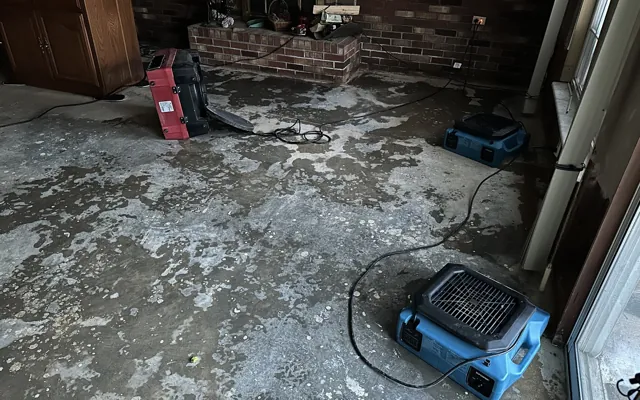
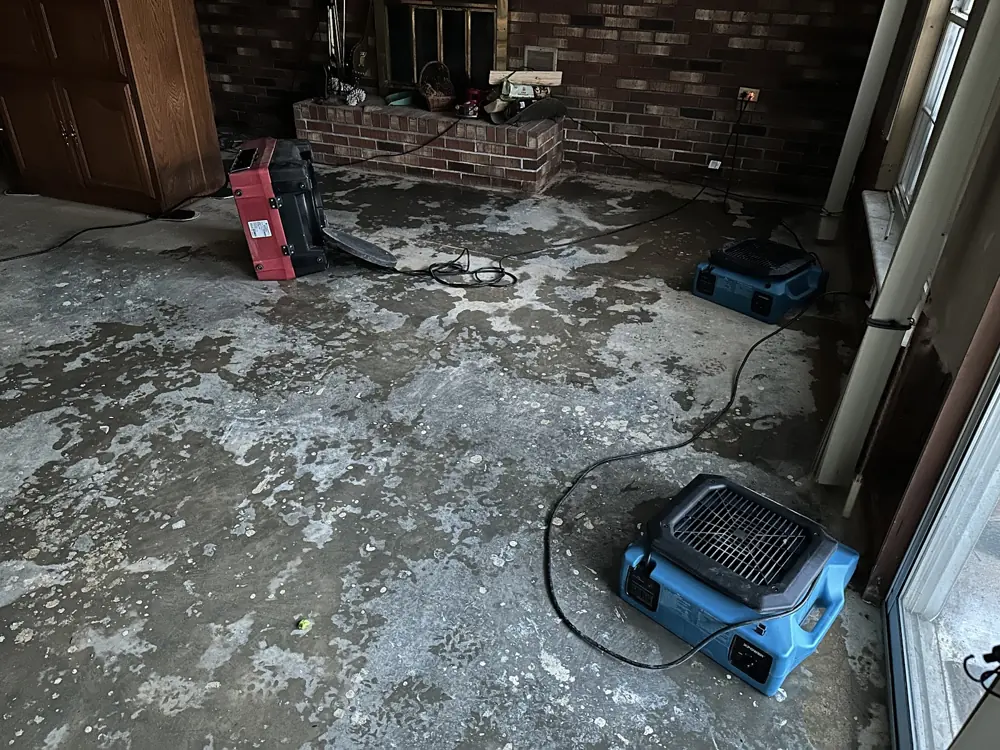
Denver's sudden summer thunderstorms and spring snowmelt can turn a dry basement wet in a matter of hours. Crews respond around the clock after storms to extract water and start drying before it spreads further.

A crew is typically on-site within about an hour after a storm to check electrical safety and assess how much water entered the structure.
Truck-mounted and submersible pumps clear standing water from basements, garages, and main floors as fast as possible.
Storm debris, saturated pad, and unsalvageable materials are removed so drying can reach every affected surface.
Dehumidifiers and air movers run until moisture meters confirm a dry, stable reading, with everything logged for the insurance claim.

While help is on the way, these first steps, done only where it is safe, limit the damage and protect the insurance claim.
Shut the supply off at the source, or close the home's main valve if the source is not obvious. Stopping the flow limits the damage more than anything else.
Switch off electricity to the affected area, but only if the breaker can be reached without standing in or touching the water.
Get a crew dispatched right away. The sooner extraction and drying begin, the more flooring, drywall, and belongings can be saved.
Take photos and a short video of the water and the affected rooms before anything is moved, so the insurance claim starts strong.
Storm and flood cleanup in Denver typically runs from about $1,200 to $6,500, depending on how much water entered the home, how many rooms or levels were affected, and whether debris or hail-related roof damage complicates the job. A single flooded window well sits toward the low end; a widespread basement flood after a major storm sits toward the high end. Sudden storm-related flooding is commonly covered under most homeowner policies, and full documentation is provided to support the claim, while separate flood insurance may apply for water that enters from rising ground-level flooding.
Crews reach Denver and the nearby metro fast, from Capitol Hill, Five Points, and Highland to Wheat Ridge, Lakewood, Englewood, and Arvada. See the full list on the areas served across Denver page.
See all areas servedEvery loss is photographed, measured, and logged from the first visit, so the paperwork holds up with the insurance carrier.
Technicians follow recognized IICRC drying standards and prove it with daily moisture readings on Denver homes, not guesswork.
Emergency dispatch any hour of the day or night, with a real crew on the way across the metro, not a callback in the morning.
A real crew dispatched any hour, not a callback in the morning.
Trained technicians following recognized IICRC drying standards.
Truck-mounted, portable, and submersible for any size loss.
The loss is documented and billed to the carrier directly.
Denver's dry climate does not prevent intense, fast-moving summer thunderstorms or spring snowmelt from overwhelming clay soils and window wells. A short, heavy downpour can flood a basement just as fast as a longer storm in a wetter region.
Sudden storm-related water intrusion, like rain entering through a window well or foundation crack during a downpour, is commonly covered under a standard policy. Rising floodwater from a river or creek overflowing its banks typically requires separate flood insurance.
As soon as it is safe to do so. Standing water left for even a day starts wicking into drywall and framing, and Denver's dry air does not dry hidden moisture on its own.
Interior water extraction and drying are handled directly, while any related roof damage from hail is best assessed and repaired by a qualified roofer, with documentation shared to keep both claims consistent.
Extraction typically takes a few hours, with structural drying running another two to five days depending on how much water intruded and how far it spread.
Denver crews are on call 24 hours a day, local and fast, and can be on the way within the hour.
Call (720) 807-8315