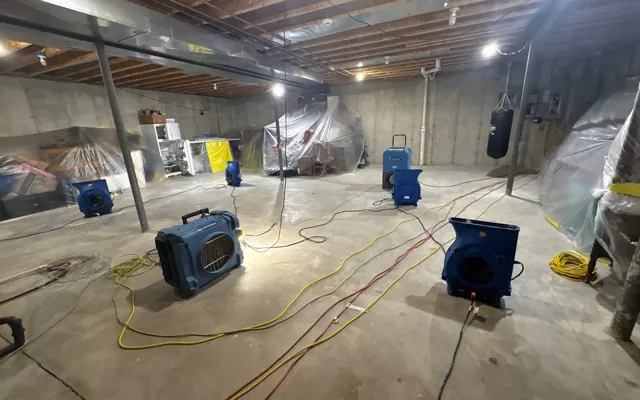
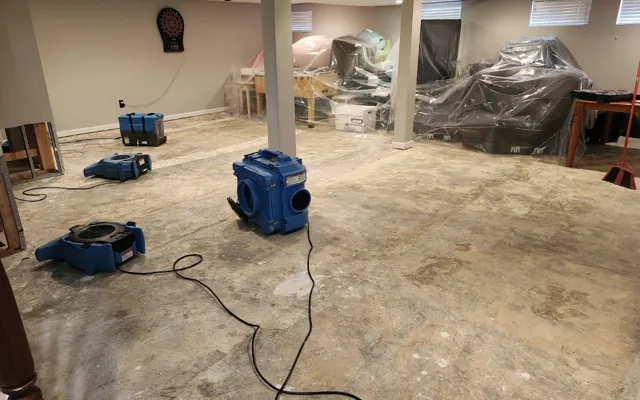
When a basement floods in Jefferson Park, CO, a local crew is typically onsite in about an hour. They follow IICRC-standard methods to extract water, dry the structure, and help homeowners get back to normal fast.

A crew reaches Jefferson Park basements quickly to check for electrical hazards and sump pump status. They assess the standing water depth and source before any work begins, ensuring a safe entry into the flooded space.
Using powerful pumps, technicians clear all standing water from the basement floor, sump pit, and crawlspace transitions. They pay special attention to saturated carpet and padding in finished basements common in the neighborhood.
Wet drywall is cut above the waterline, and baseboards are removed to open wall cavities. Industrial air movers and dehumidifiers then run until moisture meters confirm all framing and subfloors in the Jefferson Park home are dry.

Basement flood cleanup in Jefferson Park typically runs from about $1,500 to $6,000 depending on the basement's finish level, how much water intruded, and whether framing or drywall needs cutting out. An unfinished basement with a quick sump failure and clean water sits toward the low end; a finished basement with saturated carpet, drywall, and insulation across multiple rooms sits toward the high end. Sudden, accidental flooding from a mechanical failure like a sump pump is commonly covered, while groundwater seepage coverage depends on the policy, so documentation is provided either way for the claim.
Jefferson Park's low ground along the South Platte River, combined with its mix of early-1900s bungalows and newer townhomes, creates a perfect storm for basement water. Older foundations near the greenway are susceptible to snowmelt seepage, while modern plumbing in nearby infill construction can fail, bringing water into spaces below grade. In Jefferson Park, CO, older basements near the river face stormwater and snowmelt seepage. Meanwhile, newer townhomes add risks from appliance or supply-line failures. The area's dry, high-altitude climate also contributes to freeze-thaw cycles that can stress plumbing. From Jefferson Park, crews also cover nearby Cole, LoHi (Lower Highland), Baker, Whittier, Highland, Washington Park West. See every neighborhood and town on the full service area page.
See all areas servedEvery loss is photographed, measured, and logged from the first visit, so the paperwork holds up with the insurance carrier.
Technicians follow recognized IICRC drying standards and prove it with daily moisture readings on Jefferson Park homes, not guesswork.
Emergency dispatch any hour of the day or night, with a real crew on the way across the metro, not a callback in the morning.
A real crew dispatched any hour, not a callback in the morning.
Trained technicians following recognized IICRC drying standards.
Truck-mounted, portable, and submersible for any size loss.
The loss is documented and billed to the carrier directly.
Costs in Denver typically range from about $1,500 to $6,000, depending on the water's source, the basement's finish level, and the extent of damage. A simple sump failure in an unfinished space costs less, while a finished basement with saturated walls and carpet is toward the higher end.
Sudden failures like a burst supply line or sump pump are commonly covered. Coverage for gradual seepage from groundwater depends on the specific policy. Local crews provide full documentation for any claim, which helps support the homeowner's case with their insurance company.
Crews are on call 24 hours a day and can be on the way to Jefferson Park within the hour.
Call (720) 807-8315